Sooner or later, almost everyone doing business in the Sultanate of Oman — and many individuals simply managing life's paperwork — is asked for a certified translation. A court requests a certified Arabic version of an English contract. A ministry requires a certified translation of a foreign certificate. An embassy wants your academic records rendered into English by an approved office. The request sounds simple until you ask the obvious question: certified by whom, and how?
This guide explains what certification means in the Omani context, who is authorized to provide it, when you need it, and how to avoid the rejections that cost applicants weeks of lost time.
Certification Is a Legal Responsibility, Not a Stamp
A certified translation is one that carries a professional declaration: the translator — or the licensed translation office — attests that the translation is a true, complete, and accurate rendering of the source document. In Oman, this attestation matters because the translation profession itself is regulated by law. Translation offices operate under commercial licensing, and translators who handle legal instruments are expected to meet the standards set for the profession, including accuracy, impartiality, and confidentiality.
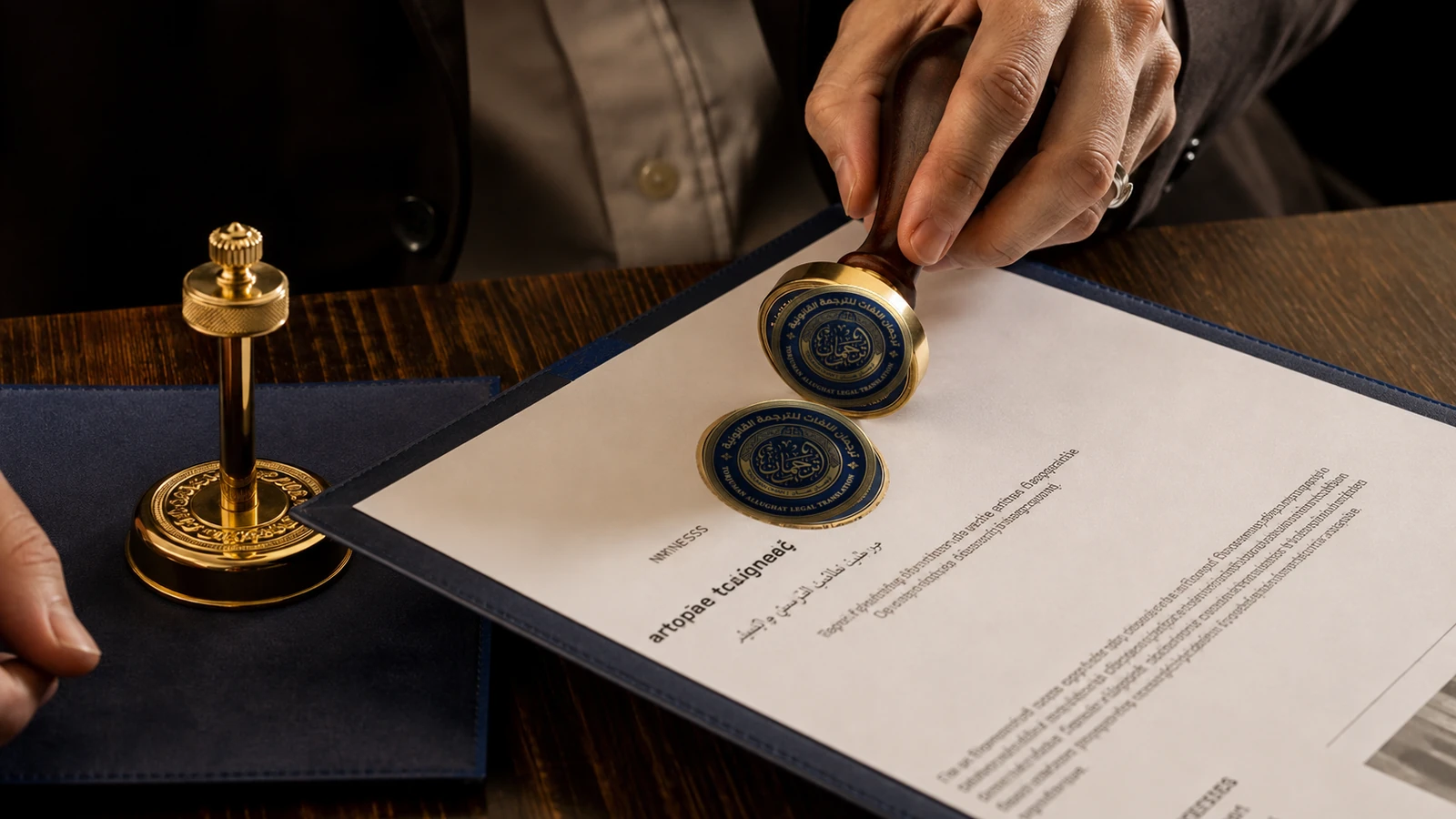
When a licensed office places its stamp and signature on a translation, it is not decorating the page. It is accepting professional responsibility for every term on it. If a dispute later turns on the wording of the translated document, that stamp identifies who stands behind the text. This is exactly why authorities insist on it: certification creates accountability.
When Omani Authorities Require Certified Translation
You will typically need a certified translation in the following situations:
- Court proceedings. Arabic is the official language of litigation in Oman. Any document submitted to an Omani court in another language — contracts, correspondence, expert reports, foreign judgments — must be accompanied by a certified Arabic translation.
- Government transactions. Ministries and public authorities generally require certified Arabic translations of foreign-language documents: incorporation papers of a foreign parent company, board resolutions, powers of attorney executed abroad, tender documents, and similar instruments.
- Embassies and immigration. Visa, residency, study, and attestation files commonly require certified translations of civil documents — birth and marriage certificates, academic credentials, police clearances — in either direction between Arabic and the destination language.
- Banks and financial institutions. Facility agreements, audited financial statements, and compliance documentation issued in one language frequently must be certified in the other before a bank will act on them.
- Corporate transactions. In mergers, acquisitions, and joint ventures, due-diligence files assembled from multiple jurisdictions are certified so that each party — and its lawyers — can rely on a single authoritative version.
What a Proper Certified Translation Looks Like
A translation prepared for official use in Oman should include several elements. First, the complete translated text — certification covers the whole document, including stamps, seals, marginal notes, and handwritten entries on the original, which are transcribed and translated rather than ignored. Second, the certification statement, identifying the translation office, declaring the accuracy of the translation, and referencing the source document. Third, the stamp and signature of the licensed office, usually on every page. Finally, many authorities expect the translation to be bound to a copy of the source document, so there is no ambiguity about what was translated.
A useful test: if the receiving authority cannot tell, from the papers alone, exactly who translated the document and which original it corresponds to — it is not properly certified.
Why Rejections Happen — and How to Prevent Them
In our experience at Torjuman Oman, rejected translations almost always fail for one of five reasons:
- The office was not licensed or recognized. A translation produced by an unlicensed individual, a bilingual employee, or an online tool carries no professional accountability, and authorities treat it accordingly.
- Names did not match official documents. The spelling of personal names must follow the passport or ID exactly. A single inconsistent letter in a name can stall a file.
- Numbers, dates, and calendars were mishandled. Hijri and Gregorian dates must be converted and presented correctly; figures must match to the digit.
- Partial translation. Omitting a stamp, an apostille, or a marginal note invites rejection — the authority sees an incomplete rendering of the instrument.
- Terminology that misses the legal meaning. Legal systems do not map onto each other word for word. Translating a common-law term into Arabic without regard for its function in Omani law can change the legal effect of the text — the most dangerous failure of all, because it may be discovered only in a dispute.
Certified, Sworn, Notarized, Attested — Untangling the Vocabulary
Clients often arrive with requirements phrased in the vocabulary of other jurisdictions. A sworn translation refers to systems (common in Europe) where individual translators take an oath before a court; Oman's system operates through licensed offices and professional accountability. Notarization is a separate act performed by a notary and typically concerns the authentication of signatures. Attestation and legalization — by ministries of foreign affairs and embassies — authenticate the document chain for cross-border use, and they sit on top of, not instead of, certified translation. A competent office will read the destination authority's requirements and tell you exactly which combination your file needs.
How Torjuman Oman Certifies a Document
Every certified translation in our office passes through a five-stage workflow: scope confirmation (document, purpose, destination authority, deadline); assignment to a legal translator working in the relevant domain; translation using court-consistent terminology and the client's approved glossaries; independent revision by a second linguist, followed by quality checks on names, numbers, dates, and completeness; and finally stamping, certification, and delivery in the format the receiving authority expects — with support afterwards if that authority raises any question.
That last stage matters more than clients expect. A serious office does not disappear after delivery; it stands behind its seal.
Practical Checklist Before You Order
- Confirm the destination authority and ask them whether they require certified translation, attestation, or both.
- Send clear, complete scans — every page, every stamp, both sides where relevant.
- Provide passport spellings of all personal names appearing in the documents.
- Flag defined terms or preferred renderings your lawyers have already adopted in related documents.
- State your deadline — and whether the authority needs hard copies, soft copies, or both.
A certified translation is, in the end, a small document with a large job: it lets an Omani authority act on a foreign text with confidence — or lets the world act on an Omani one. Give it the professional care the law expects, and it will open doors on the first attempt.
Frequently Asked Questions
How long does a certified translation take in Oman?
A standard certificate or short official document is typically ready within one to two business days. Contracts and court bundles depend on volume: a well-run office will quote a firm timeline at the outset and offer an express lane for urgent court filings or tender deadlines. What matters is that speed never bypasses the revision stage — an urgent translation is compressed in schedule, never in process.
Does a certified translation from Oman work abroad?
Generally yes, provided the right authentication chain accompanies it. Many foreign authorities accept a translation certified by a licensed Omani office directly; others require additional attestation of the underlying document through the Ministry of Foreign Affairs and the relevant embassy. Always confirm the destination authority's requirements first — the answer determines the order of steps and the total cost.
Can I translate the document myself and have an office stamp it?
No reputable office will certify text it has not produced or fully verified, because the stamp transfers professional liability to the office. What a good office can do is take your draft as reference material — particularly for preferred terminology — and produce a certified version that benefits from it.
What should I send to get an accurate quote?
Clear scans of every page (including stamps and reverse sides), the destination authority, the deadline, and passport spellings of any personal names. With those four items, a professional office can commit to a price and a date in one reply.